Thursday, 20 February 2014

Valentines Day at FameLab

As two of the things I love are science and talking, what better way to spend my Valentines night than at the regional final of FameLab 2014? Arriving at the museum of science and industry to a room decorated with marshmallow hearts to a goody bag I knew there was no better option! 

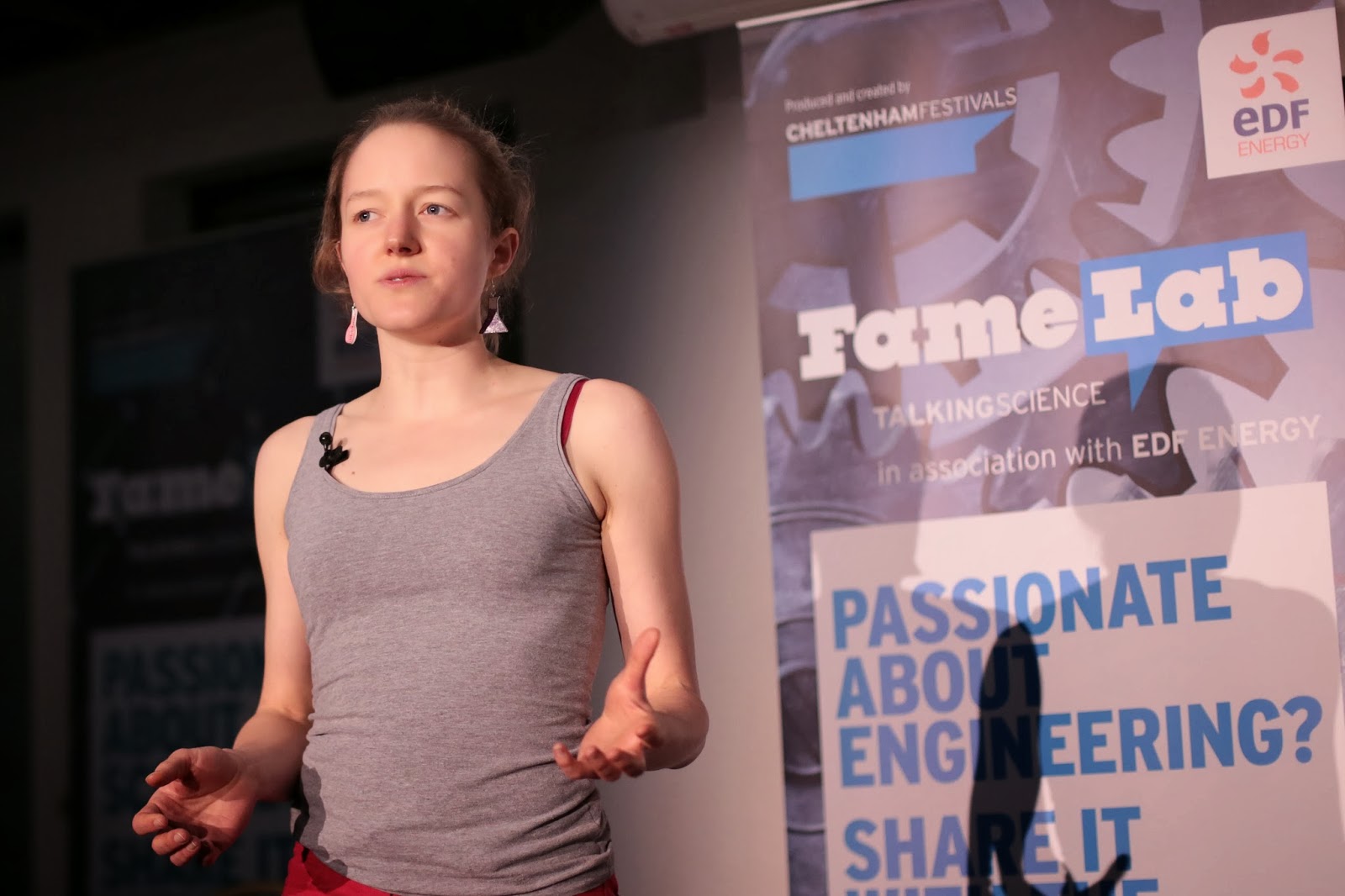
The running order showed that I was on 5th out of 9 - and the nerves started to kick in! the range of topics presented was vast: from the dating scene of worms to the use of positrons in medicine. I spoke about energy: where we currently get it from and where we could get it from in the future.  My presentation went reasonably well but, as in Birmingham, the judges felt I could have gone for more technical content. Below are a couple of photos from the event and here is a (rather out of focus) video of my presentation, followed by what I was planning to say!! 

© MOSI / Chris Foster Photography

© MOSI / Chris Foster Photography
We use energy for everything: from the calories we eat to the electricity we use to charge up our smartphones. But where does this energy come from? Well, and this might be surprising, here on Earth, all our energy originally comes from the Sun.
But how do we transfer this solar energy into something we can use? Currently, we cheat, and we use these guys: *plant*.

Plants use photosynthesis to convert the radiation from the sun into chemical energy in the sugars that help them grow, making them into tall, green, attractive looking lunches for an animal. Prehistorically, once animals had gone through a lifetime of nibbling at greenery, their bodies became buried under layers of mud and rock. After millions of years of high pressure and temperatures, they decomposed and formed fossil fuels, such as oil or coal. This long and intensive process has converted solar energy into an energy dense material that is really easy for us to transport and burn when we need the energy. However, we are using the Earth's supply of these fossil fuels much quicker than they can be replenished. Therefore, we need to start using alternatives, and harness sunshine in different ways.

So we move on to another form of energy: electrical energy, the movement of electrons inside a material. Silicon has the special property that when it is exposed to sunlight, the radiation knocks electrons out of the molecules. These electrons can then move through the material and, hey presto, we have transferred radiation into electrical energy. This the the process that occurs inside photovoltaic cells, like this one in my calculator. Now this is a form of energy we can use here in the UK. Solar cells work well even in our climate, and we can store the electrical energy in batteries for when it gets dark.

And so this is how we can use the energy from the sun, all on our own, without relying on plants to do our dirty work for us.

Wednesday, 12 February 2014

FameLab 2014 take 2: Manchester

After my ill-prepared trip to the FameLab heats in Birmingham, I decided to spend my birthday travelling up to take part in the heats at the Museum of Science and Industry (MOSI) in Manchester, along with a friend who had the intention to go the ones in Birmingham but never made it. 


Much better prepared, I really enjoyed presenting my work. The video of my presentation is here: http://youtu.be/eUz33byE1u8 enjoy!! All the contestants in my heat were also great - including the first human power point I have seen... After waiting anxiously all afternoon, I found out that I had made it through to the regional final! Definitely worth the trip up - and wish me luck for Friday! Come and watch if you're in Manchester...

Monday, 10 February 2014

Oxford Climate Forum

The evening of the 7th February not also saw me turn 25, but also the beginning of the Oxford Climate Forum. This is the UK's highest profile student-led conference and saw a large range of high profile speakers interspersed with panel discussions and a parallel careers fair. The aim was to leave us "Inspired, Motivated and Empowered". 


Friday's first keynote speaker was Dipal Barva, founder of the "Bright Green Energy Foundation" based in Bangladesh. He has been a key player in introducing solar and biogas to rural areas to improve the socio-economics. What they have done is amazing: from few grid connections, they have installed huge numbers of solar panels and biogas boilers - enabling those in rural communities to have access to "clean light" and less polluting cooking systems. My concern was the sheer number of batteries used, but they have introduced incentives for recycling them to reduce waste. 

Dipal was followed by Professor Nigel Brandon, Dr. Nick Eyre, Trevor Nash (Sargas) and Dave Worthington who engaged in a lively discussion about the future of our energy system.  The consensus seemed to be that the technology is ready, but it is the political and social will that is causing a delay to action. Dr. Eyre suggested this was because people are now so disconnected with energy - no longer having to carry it into the house in a bucket! This gave me ideas for my next FameLab talk....

The speaker of Friday was Martin Chilcott, CEO of 2degrees, who began by showing a video illustrating the growth of the world population which was pretty shocking! However, using the mandarin for crisis, which is the combination of danger and opportunity, and the fact that the US now offers more jobs in solar than in oil and gas combined left us feeling positive. 

Saturday began with some moral philosophy from Professor John Broome, who explained how, because we should not inflict harm on others, it is our moral obligation to offset our CO2 to reduce our net emissions to zero. Apparently each of us in the UK shortens someone's life by 2-3 days just with our annual carbon emissions. However, he separated this "justice" from "goodness", which can be achieved in more efficient ways. 

The next panel started with Robert Hunt from Veolia, who has worked a lot in London to reduce emissions from waste. They have saved 9% of their fuel costs by changing the behaviour of their drivers! They have also created a visionary document: Imagine 2050, which portrays the way waste could be managed in the future. 
Dr. John Ingram gave an interesting presentation on food security, and showed shocking predictions to the number of people in the world eating "too much" and "too little". He showed how much food we would gain by eating food currently used for fuel and feeding livestock. 

The afternoon brought the session I was most looking forward to: Communicating Climate Change. James Painter reminded us that most people still get their news from mainstream media, with social media remaining low on the "Trusted sources" list. Ade Thomas, from Green TV stressed the importance of visualisation, illustrated by the Connect4Climate video competitions that have spread information about climate change all over the globe. Their key message was to know the aim of your communication, as this will determine how you do it! 

After just over a day of talks on a huge variety of climate change related topics, I agreed with the organisers that climate change can be viewed not just as a danger, but also as an opportunity for research and development. Inspired by the success stories, I left feeling ready to help take on the challenge! 

The New Optimists: The Next Generation

A few months ago, at a ScienceGrrl event, I met Kate Cooper: founder of "The New Optimists".  This organisation asks scientists "What are you optimistic about?" and publishes their answers online and in print. Kate summarises their motivation in a few paragraphs:
"Science really matters. It’s taken humanity on its most enlightening, its most exciting, its most productive — and potentially the most catastrophic journey of any specie on the planet ever.
The best, perhaps our only option to avert the potential catastrophes facing us is to take heed of the iconoclastic knowledge and sometimes conflicting perspectives of scientists.
What we’re doing here is to create different platforms for individual scientists to tell us what they do and why it matters, and for their collective scientific endeavour to enable better informed decision-making."
The latest expansion to the New Optimists' activities is to create a group of "Young Optimists": scientists in the early stages of their career who are interested in spreading the word about all the great things they are discovering through their research. 

Last week saw the first two meetings of the Young Optimists: one on Thursday at Yorks bakery and one on Saturday night at the Old Joint Stock. Tempted by two of my favourite things (cake, and talking about science) I battled the rain into town on Thursday evening. It was definitely worth it! There were about 12 of us there, from a wide range of disciplines and from all over the local area. After introducing ourselves, Kate encouraged us to ask questions of each other, prompting some really interesting discussions, from linking cancer and evolution to driver-less cars and behavioural change! 

It's currently a project in its early stages, but the aim is to record some of these discussions, as videos or podcasts, to reach out to a wider audience. Personally, I can't wait to get the group together again - it't great to learn more about research you only catch in the news!

More details of the other young scientists involved can be found through the write-up of the events on the new optimists website: http://newoptimists.com/2014/02/09/scientists-in-the-city-the-next-generation/#more-8299. 

Friday, 31 January 2014

Public Speaking and Research Communication Masterclass, Loughborough

Yesterday I was lucky enough to attend a masterclass run by Screenhouse (Barbara Govern @screenhouseprod, Paul Bader @paulbader, Victoria Pritchard @vic1redvoice) and Dr. Maggie Aderin-Pocock. It was a really fun day and I left feeling inspired to take on any public speaking opportunity that comes my way!

The day began with us hearing from Maggie about her route into the media and what would await us if we chose to follow a similar path. She acted as an excellent role model, encouraging us to take opportunities rather than immediately passing questions on to someone more senior. They may not be a better communicator!

She then did a really interesting SWOT analysis of getting into TV presenting...
  • Strengths include communicating your research out to a wider audience and getting your opinions heard. It can also be a great confidence booster!
  • Weaknesses of time consumption and misquotations were mentioned, although the words "It's worth it" were mentioned a lot!
  • Opportunities for female experts are appearing and being flexible about time and place but stubborn about content should allow you to use them. 
  • Threats to your career and social life were the key disadvantages, but support is out there (e.g. STFC fellowships) - make the most of it!
Paul Bader from Screenhouse then took over to give us an introduction on how to present our work in a media release. The difference between writing styles was highlighted: the formality, detailed and tentative nature of academia vs the definite but broad stories told by the media. 

In general, a newspaper piece will tell the story 3 times:in the headline, the first paragraph and the conclusion. As with my writing course at ThinkTank last week, we were encouraged to take as many words out as possible - you should be able to summarise your story in one sentence. 

We then split off into pairs to come up with a headline and a first paragraph describing our research. Quotes add personality and authenticity to a piece and it's useful if you prepare yours in advance of talking to a journalist.
After a lot of crossing out, I finally came up with a headline:
 "Powders used to store hydrogen in vehicles prevent the need for high pressure tanks." 
and a quote:
"Currently, we use chemical hydrogen storage on a narrowboat here at the University of Birmingham, but the challenge is to make the system lighter for use in smaller vehicles such as cars"
Next came a different kind of exercise - the tables were pushed to the side of the room and Victoria Pritchard took over. She wanted not to encourage us to be more confident, but for us to be ourselves, confidently. This means embracing personal traits like accents without becoming overly loud or enthusiastic. During the course of this session, you could see huge improvements made within the group.

After lunch we split into 3 groups and were immediately put in front of a camera! We had 60 seconds to talk about something we felt enthusiastic about, and then we watched all the tapes back afterwards. This was awful! No-one in my group enjoyed watching themselves back, even though we'd all done a pretty good job - maybe this is a general lack of self-esteem?

My group as a whole was encouraged to give the viewer time to think - we have an association between slow and calm speakers and authority, so embrace the full stops! It was also really interesting seeing the effect of facial expressions on the tone of your voice. It is very hard not to be mono-tonal when you are expressionless...

I was advised to relax my shoulders, allowing me to breathe more deeply. To practice this I was given two tennis balls to put in my armpits! 

After two opportunities in front of the camera, we came together as one group and everyone got a chance to resent their 90 second piece to everyone. I loved this as the bigger the audience, the better, for me! It was great to see how everyone had improved, and the confidence level in the room was sky-high by the time we had all finished. 

All-in-all, it was an excellent day - thanks to all the organisers and Maggie for speaking. I feel very encouraged and inspired ahead of next week's FameLab heat in Manchester - Bring It On! 

Thursday, 23 January 2014

"Writing for the Public" at ThinkTank

Late last week I was reading through the College of Engineering and Physical Sciences' newsletter and saw a "Writing for the Public" afternoon workshop at ThinkTank advertised. After enquiring, I discovered it was only for staff members, but then at the last minute I was told there was enough room on the course for me to go! The course was funded by the EPSRC, giving me yet another reason to be very grateful to them. So I eagerly headed back to ThinkTank for the second time in a week, keen to learn about how they make their science exhibits so appealing to the general public. 

Kenny Webster (@KennyWebster) was leading the workshop and began by showing us their "News Releases" exhibition. This is a touch screen which displays scientific news stories - the visitor sees a list of pictures and headlines, and then taps through to read the "article". I use quotation marks as they are less than 100 words long! These are usually 3 pages of around 30 words each and give a snapshot of current research, as they are one of the exhibits in the museum that can be updated very quickly. So quickly, in fact, that we were then told that the articles we wrote during the session would go live in the museum the next morning - very exciting, but also quite nerve-wracking! 

Luckily, before we started writing, we were given some tips on how to make our stories stick in people's minds once they had left the museum: how to make them "sticky". As with any workshop, there came an acronym, so hear is the path to SUCCESS:
  • S is for Simple (although the word Clear is more appropriate, as ThinkTank are keen not to dumb-down science). The articles should be about one topic and the core message should be possible to explain in a sentence. 
  • U is for Unexpected. Everyone loves a bit of mystery, and it's a great way to encourage people to read further, however it must be something that is surprising to the general public: it is important to think about what they already know. Is it possible to create a knowledge gap and then fill it?
  • C is for Credible. Can you add details that show the information is from a trusted authority? Be wary of statistics and units: changing something from tonnes to elephants doesn't necessarily make it more accessible!
  • C is for Concrete. Give people something tangible, that they can relate to. This led onto an excellent discussion on the use of nouns. (Now there's a sentence I never thought I'd say....!) For instance, "bicycle" is much easier to think about than "justice". The noun that prompted the discussion was "excellence" which we decided could mean whatever you wanted it to! 
  • E is not for Excellence, but for Emotional. Why should someone care? Because they have self interest in the story? Because they can associate themselves with the characters involved? Or does it effect people like them?
  • S is for Story. I remember reading an interview with Ed Yong, about the power of a story, and how they can always hold your attention, even when you're exhausted in an airport waiting lounge. Offer the reader a structure, allow people to "live" the article, and they'll be with you until the end. 
After hearing these words of wisdom, we were encouraged to go off and write our own piece for the museum. I say write, but most of my time was spent deleting! The course began with a quote from Pascal: "If I'd have had more time, I'd have written less", and this became very relevant once we began! 

I decided to write a piece not on my own research, but on a topic that had proved "sticky" for me in the past: bacteria that can sift through waste water and selectively collect palladium at their surface, forming metallic "jackets". A colleague of mine from the Doctoral Training Centre, James Courtney (@jmc991) spoke about it during his FameLab audition last year (you can watch it here) and I loved the idea of bacteria with bling. 

After about 45 minutes, and reading this article over and over, I managed to cut the story down, and this is what I ended up with: 

Bacteria with bling

Kevin Deplanche
Metals like palladium and gold are used a lot: from cars to jewellery. But supplies are running low and because of this, they are getting more and more expensive.

Researchers at the University of Birmingham have found bacteria that collect these metals at their surface and form a jacket of gold or palladium around them.

These bacteria can be used to collect precious metals from industrial waste, reducing the need for mining and lowering the cost.

So if you're wondering around ThinkTank in the next few weeks and see the above on the "News Release" screen, then you know where it came from! I definitely plan to write some more: watch this space!

Monday, 20 January 2014

Why water is weird and FameLab is wonderful

This weekend I had another go at FameLab, the three minute science communication competition. Again, the competition was brilliantly hosted by @KennyWebster and his team at ThinkTank - the science museum in Birmingham. The standard was exceptionally high, and it was a great afternoon packed with talks on a range of topics from double pendulums to evil basil plants! I wish everyone going forward to the next round the best of luck: and I'd recommend to everyone that they should go and watch the regional final, the judges will have a tough time! (Wed 29th January, again at ThinkTank)

I hadn't had much time to prepare this year and it showed a bit: I wasn't as comfortable presenting as I normally am. 
I spoke on the amazing properties of water and I have posted the transcript below if you fancy learning something new. 

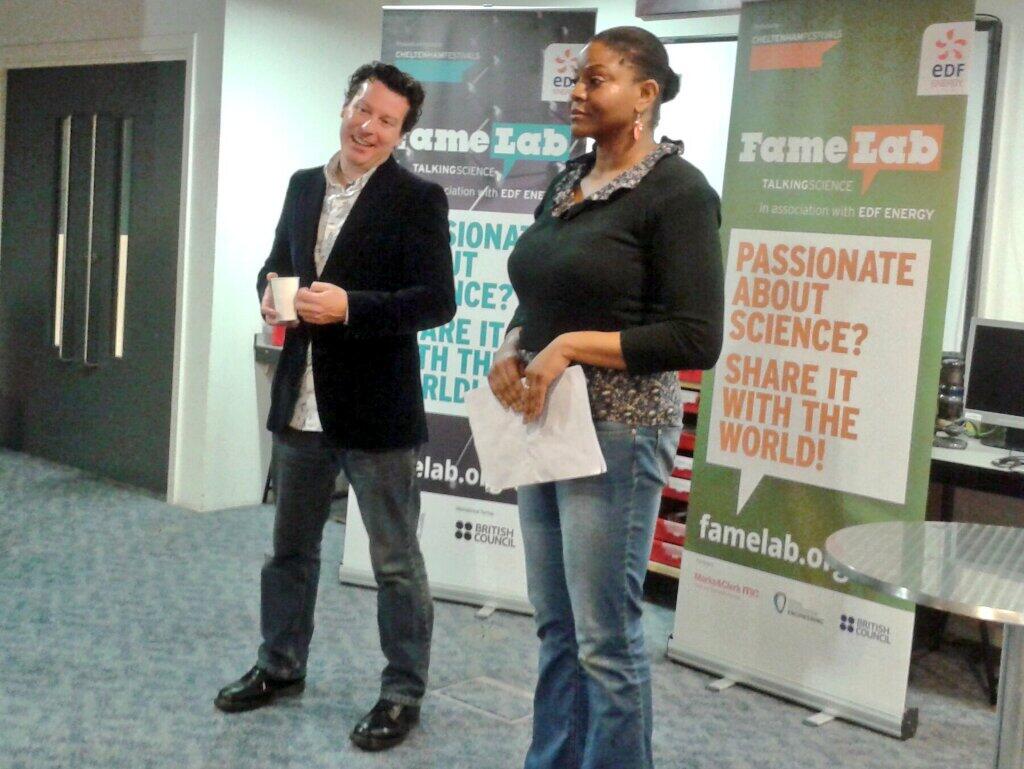
Afterwards, the judges Jon (@Jonwoodscience) and Josephine (picture, right) gave me some great advice on the topic and the way I presented. 

Along with a friend who registered but chickened out at the last minute, I plan to go up and have another go, entering the heats in Manchester next month! Wish me luck!!


Water, water everywhere, but it's not as simple as you think...

Water is made up of two hydrogen atoms and an oxygen atom: H 2 O. If it was as simple as that, you would expect the shape of a water molecule to be linear: all the atoms lined up in a row, but that's not the case. Water has a kinky secret, and it's all about electrons...

Each hydrogen atom has one electron and each oxygen atom has 6 available for bonding. Each hydrogen uses one of its own and one of the oxygen's electrons to form a bond, leaving 4 remaining electrons around the oxygen. These pair off with one another and are called 'lone pairs'. This gives us four groups of electrons around the oxygen atom: two bonds to hydrogen atoms and two lone pairs. These four groups are negatively charged and therefore all want to be as far apart from one another as possible.

Imagining your hands are lone pairs and your legs are bonds to hydrogen atom shoes, take a big step forward and lift your arms into a "Y" shape. You are now a water molecule! As the lone pairs are not visible, the water molecule is not linear, but kinky at an angle of 104.5 degrees to be precise. Which is lucky for me, as I can't do the splits...

So why is this kink so special? Well, the electrons in the bonds holding the hydrogen atoms to the oxygen are not evenly distributed: the oxygen has a larger and stronger positive core and so pulls the electrons closer to it: making the hydrogen end of the bond slightly positive and the oxygen end slightly negative. This is called a polar bond. (nothing to do with bears).

As they say, opposites attract, and my two negative lone pair hands are desperate to grab onto some positively charged hydrogen shoes and form what is called a 'hydrogen bond'. Now this is what makes water different. Because of having two lone pairs and two polar bonds, each molecule can form a hydrogen bond to four others: one in each hand and one to each leg. At room temperature, when the molecules are moving around, they won't get the chance to form all four, but as the temperature lowers, all the water molecules come together to form a circus act: making a large structure with big gaps in. Ice. These gaps mean that ice is less dense than water and floats on the top, unlike most molecules, which huddle like penguins when they get cold and form a solid that is denser than the liquid.

There are other molecules that can hydrogen bond, but not to the same extent: ammonia is the equivalent of having 3 legs and hydrogen fluoride one leg and three arms. Because they have less chance of grabbing onto one another when flying around at room temperature, these molecules are all gases. And because they'll always be a spare arm or leg, they cannot form a structure like ice.

So that is why a little kink makes water so wonderful: I urge you to go forth and hydrogen bond!! (although circus training might be recommended)